
Cycle Snapshot #3
Selectivity Beneath the Noise

Markets have spent the past few weeks navigating another period of volatility and uncertainty.
Sentiment has weakened, headlines have become more erratic, and investor behaviour has reflected a degree of hesitation. This type of environment typically leads to a broad pullback in risk, particularly in areas of the market associated with duration and future growth.
At the same time, the broader position within the cycle continues to point toward allocations in technology, small caps, and higher-beta assets.
On the surface, that appears contradictory.
But it isn’t.
Not Withdrawal — Selectivity
What we are seeing is not a broad withdrawal from risk, but a shift toward selectivity.
Capital is not leaving the market entirely. It is becoming more deliberate, favoring areas with structural support, strategic relevance, and clearer long-term demand.
In periods of geopolitical uncertainty, investors tend to avoid fragile duration. But they do not abandon long-term themes altogether. Instead, they gravitate toward assets where future growth is supported by both technological progress and institutional backing.
That distinction matters.
Because it explains why some areas struggle, while others continue to hold structure.
Why Space Equities Are Holding Up
One area that continues to stand out is space equities.
Despite being typically classified as small cap, high beta, and long-duration, several companies within this sector have shown notable resilience. Since the November 2025 lows, many names have continued to trend higher even as broader markets have moved lower.
That type of relative strength during uncertainty is not random.
It suggests capital is already positioning.
The explanation lies in the nature of the sector itself.
Space represents an early-stage infrastructure layer within the next phase of technological development. It sits at the intersection of communications, defense, data, and global connectivity. Unlike more speculative areas of the market, demand here is not purely sentiment driven. It is supported by long-term capital expenditure, government funding, and strategic priorities.
Volatility vs Structure
On lower timeframes, this sector can appear volatile.
Price action can be sharp, reactive, and at times difficult to interpret.
But when viewed from a higher timeframe, a different picture emerges.
Structure remains intact.
Across multiple names, price has:
Held key support levels
Maintained trend channels
Continued forming higher lows
This is not the behavior of a sector under distribution.
It is more consistent with controlled consolidation and gradual accumulation.
UFO, Quarterly Chart
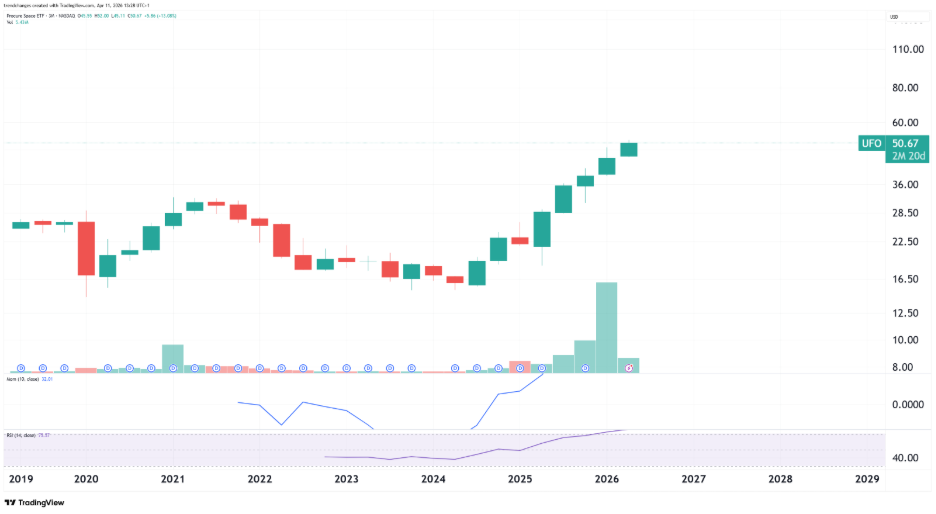
Equity markets had a volatile 1st quarter whilst capital continued to gravitate towards the space industry. Looking at the space etf UFO, of note is the large volume spike showing increasing accumulation during volatility and uncertainty, highlighting the contrast between broad market behavior and this emerging sector.
Nasdaq, Quarterly Chart
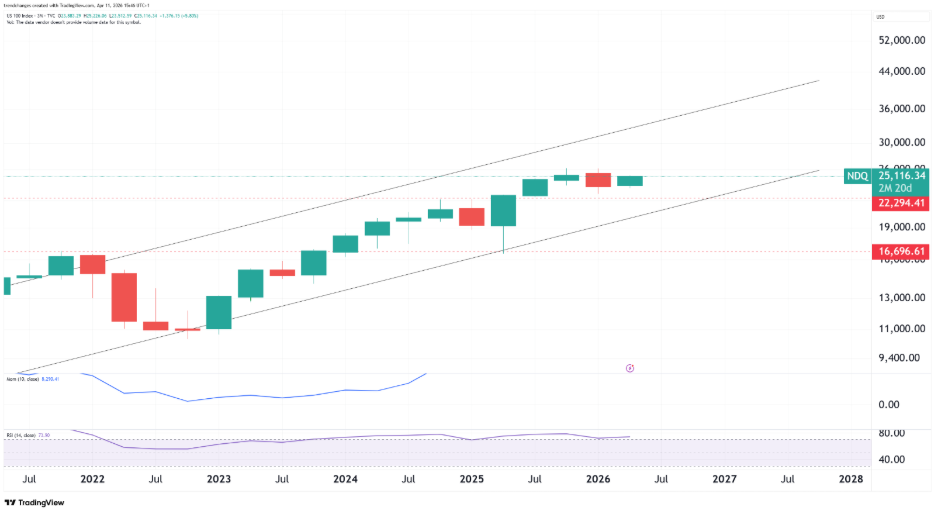
Sentiment towards technology appears to be improving, but the structural difference between the Nasdaq and space equities is becoming clearer. Technology experienced distribution during Q1, while space equities showed signs of accumulation, suggesting rotation is taking place but remains camouflaged through selectivity.
This type of divergence is often seen during transitional phases of the cycle, where capital begins repositioning ahead of broader confirmation.
The Government Bid
Another factor supporting this behavior is the presence of government demand.
Space infrastructure is increasingly tied to defense and national security. Satellite networks, communications systems, and data capabilities are no longer optional — they are strategic necessities.
This creates a different type of bid.
During periods of volatility, while purely speculative capital may withdraw, government-backed demand remains. That provides a level of underlying support that is not present in many other high-beta areas of the market.
Positioning Ahead of Confirmation
The key takeaway is that strength in this sector is not being driven by optimism.
It is being driven by positioning.
Investors are not waiting for confirmation in the data. They are allocating ahead of it, based on the alignment between macro conditions, long-term demand, and structural price behavior.
That often happens early.
And it rarely feels comfortable at the time.
Looking Ahead
In the paid tier this week, I’ve broken this down in detail across the space sector, looking at companies positioned at different points along the risk curve — from stable infrastructure providers through to more speculative, high-beta opportunities.
Because while the theme is consistent, the way capital moves through it is not.
And that’s where the opportunity tends to emerge.
Note: Some sections of this article were developed with the assistance of A.I. editing and drafting tools. All final analysis, trade ideas, and opinions are my own.
Not investment advice. Readers are strongly encouraged to perform their own due diligence and, where appropriate, seek guidance from a qualified financial advisor before making investment decisions.
J.B.